Neurosurfer
Neurosurfer is a Python framework for building AI agents — models that don't only answer questions but do things: call tools, read files, search the web or your own documents, and work through a task in several steps. Wire those steps into a graph yourself, run it against Anthropic, OpenAI, Gemini, Bedrock or a model on your own machine, and serve any of it behind an OpenAI-compatible API.
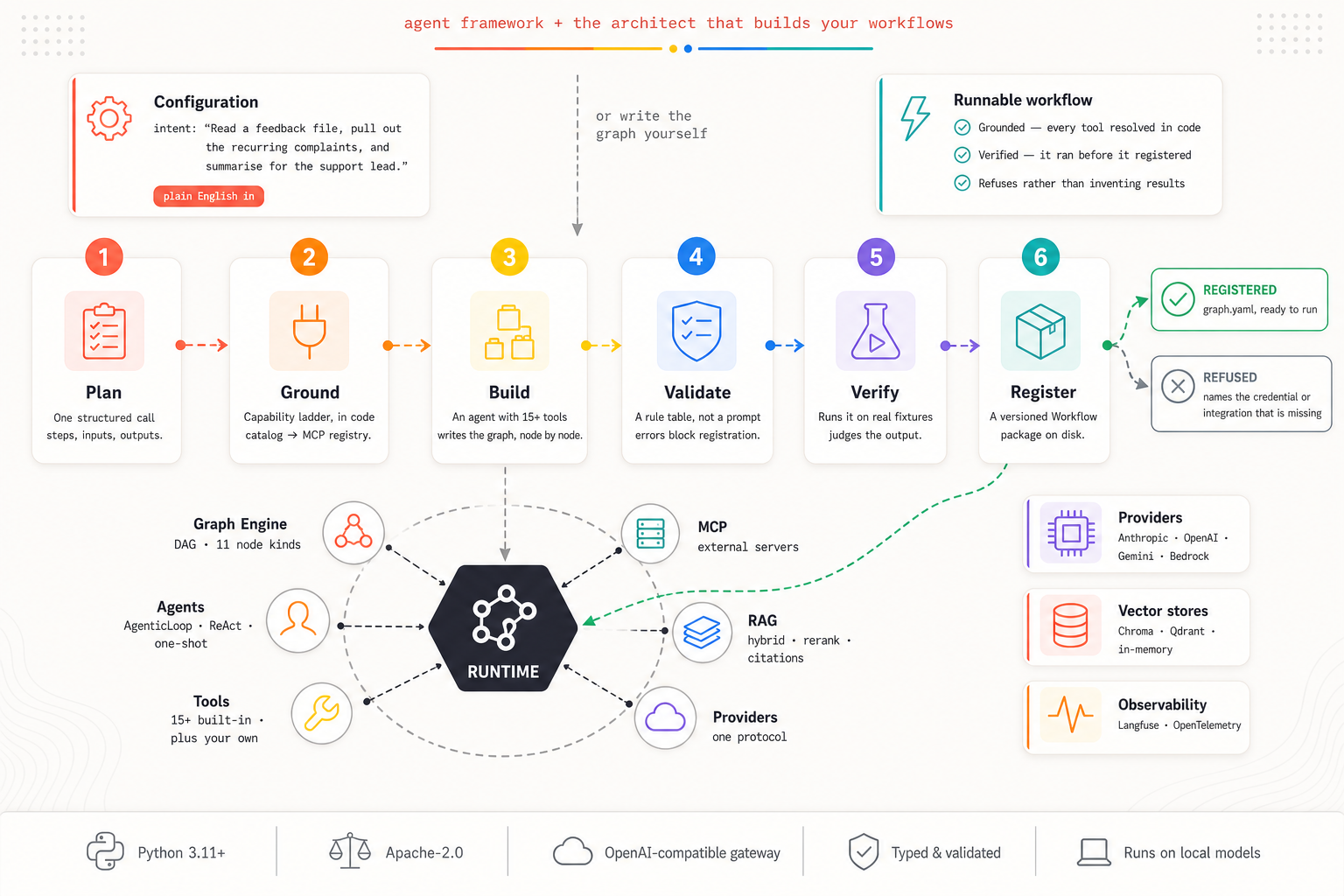
The Architect is the second way in: describe what you want in plain English and it builds the workflow for you — working out which tools the job needs, running what it made to check it works, and saying plainly when something can't be built rather than returning results it invented.
-
Get started
Install the package and run your first agent in a few minutes.
-
Interactive CLI Agent
Chat with an agent, manage provider profiles, wire up MCP servers, and build workflows — all from one REPL, no Python required.
-
Agents
AgenticLoop,ReactAgent, and one-shotAgentwith streaming events. -
Gateway
Serve any agent behind an OpenAI-compatible
/v1/chat/completionsAPI. -
Graph & Workflows
Eleven node kinds, branching, loops, fan-out, and a validation gate — saved as runnable packages.
-
Tutorials
Hands-on Colab notebooks from install to a full capstone project.
What's in the box
- Agent family —
AgenticLoop(native multi-step tool-use),ReactAgent(text-parsing ReAct for models without a native tool API), andAgent(one-shot, optionally with structured output). - Provider layer — Anthropic Claude, OpenAI, and any OpenAI-compatible server (Ollama, LM Studio, vLLM, llama.cpp) behind one
Providerprotocol. - Tools — 15+ built-in tools (web search, sandboxed Python, file ops, HTTP, headless browser, read-only SQL, and more) plus a simple framework for your own.
- A tool registry — every tool declares a capability tag from a closed vocabulary, so a need resolves against a declaration rather than against words a description happens to share.
- RAG — ingest → chunk → embed → retrieve → token-aware context injection.
- Graph & Workflows — a standalone DAG engine with eleven node kinds, branching, loops, fan-out, human-in-the-loop pauses, and a validation gate — saved as runnable Workflow packages.
- Architect — describe a workflow in plain English; it plans, grounds every capability against what exists, builds the graph, and proves it by running it — or refuses with a reason.
- MCP client — connect external Model Context Protocol servers, or discover and install one from the registry when a capability is missing.
- OpenAI-compatible gateway —
/v1/models+/v1/chat/completionswith SSE streaming, upstream proxying, native-agent backends, and request/response hooks — plus workflow and architect APIs. - Interactive CLI agent — a full REPL for chat, provider profiles, MCP servers, and workflow building, plus a
servecommand for the gateway.
Install
See Installation for the full list of optional extras, and Upgrading if you are moving from an earlier release.
Neurosurfer is a set of layers you can adopt independently. Use a bare provider for one call, an agent for multi-step tool use, a graph for orchestration, or the gateway to serve any of them behind an OpenAI-compatible API.
The layers
- Providers (
neurosurfer.llm) normalise every model behind oneProviderprotocol and a canonical message/response model, so nothing above cares which vendor you use. - Agents (
neurosurfer.agents) turn a provider + tools into a run loop that streams typed events, gates dangerous actions, and manages the context window. - Tools (
neurosurfer.tools) are what an agent can do — file ops, shell, web search, sandboxed Python, HTTP, browser, SQL — plus MCP tools from external servers. - The registry (
neurosurfer.registry) is what makes those tools findable: each declares a capability tag from a closed vocabulary, so a need resolves against a declaration rather than against words a description happens to share. - RAG (
neurosurfer.rag) adds ingest → chunk → embed → retrieve with token-aware context injection, backed by pluggable vector stores. - Orchestration (
neurosurfer.graph) runs multi-node DAGs of functions, tools, and agents — with branching, loops, fan-out, and a validation gate that refuses a graph before a model is called. - Authoring (
neurosurfer.architect) designs those graphs from a plain-English description, grounds every capability it names against the registry, and proves its work by running it. The runtime never imports the authoring layer. - Gateway (
neurosurfer.app.server) exposes any of the above as a model at/v1/chat/completions, with SSE streaming, upstream proxying, and request/response hooks — plus the workflow and architect APIs. - Observability (
neurosurfer.observability) is a cross-cutting layer: every agent run emits a trace to Langfuse or any OTLP backend with zero code change.
How a request flows
- You build a provider (from env/profile) and a tool pool.
- You construct an agent and call
run(prompt)— an async generator of events. - Each turn the agent streams the model, and on tool calls it gates them through guardrails and the
iohandler, executes, and feeds results back — until the model finishes. - If tracing is enabled, a side-channel observer maps those events to a trace without touching the agent.
- Behind the gateway, that same run is wrapped as an OpenAI
/v1/chat/completionsresponse.
See Core Concepts for the canonical types and the event lifecycle, and Permissions & Safety for how gating works.
License
Licensed under the Apache-2.0 License. See LICENSE.